Tuesday, 14 April 2015

Organizational Learning, Knowledge and Capabilities Conference


Vivienne Bozalek, Wendy McMillan and I just attended the OLCK Conference in Milan at the Università Cattolica del Sacro Cuore - a beautiful old campus. So old that some of the venues had relics on display, one even had a necropolis from the third century AD - I hope that is not a metaphor for the university today! The conference has a focus on organizational management and a theoretical underpinning of the conference was a practice based approach. It was extremely friendly and non-pompous, and one great feature during the parallel sessions was a series of symposia on a theme,

for example authorship, with three presentations and  after each presentation there was a respondent, before the discussion was opened to the floor. This worked particularly well.

A highlight was the second keynote by Silvia Gerardi, who spoke both on affect and on theorizing practice (Gerardi, S. 2012. How to Conduct a Practice-Based Study: Problems and Methods, Cheltenham: Edward Elgar). Her writing is very accessible for those who want to be introduced to theorizing about practices. There were several innovative ways of presenting and communicating at the conference, one of which was a talk artist, who drew on a large surface while Silvia was talking. (See at the beginning of this post.) Another was the conference dinner, where a pianist was accompanied by a percussionist and an artist. His completed work is also shown here.

I gave a presentation on the Structure, Culture and Agency (S, C, A) project. The paper was asking some questions about the kinds of theories we use in our research, how we go about choosing them,  whether theories can be combined, and how. I used the data from the project to illustrate these points, showing in the process that some issues are better explicated through a social realist approach, and some issues through a practice based/socio-material approach. However, there are aspects of these two approaches where they appear to be commensurate, and aspects where they do not appear as commensurate. I am hoping that these questions will receive more airtime in the future, as myself, Vivienne Bozalek and Peter Kahn are planning to edit a book on the question of theorising learning to teach and I am hoping that quite a lot of the data from the S, C and A project will be featured in the book.


Thursday, 12 February 2015

Can theory enable us to speak back to power?


As a new contributor from Melbourne, I am most impressed by the longevity and depth of the Structure, Culture and Agency research project. 
I would like to introduce myself as a researcher at La Trobe University, taking part in an international study with Brenda (and others) on the topic of knowledge practices in teaching & learning. The study is bringing together a corpus of interview data from five universities in the UK, South Africa and Australia, led by Tai Peseta from Uni of Sydney. The title is "The flow of new knowledge practices: an inquiry into teaching, learning and curriculum dynamics in academic work-groups", where workgroups is a term used by Trowler to describe how academics put their new knowledge and know-how about teaching and learning to work. This study looks like it shares ground with the Structure, Culture and Agency project. 
The study also offers the rare prospect of a team of researchers bringing different theories and approaches to one investigation– in particular the two approaches mentioned in the 'Focus on Theory' posting of 28 January, namely on critical realism and sociomaterialism. 
I plan to contribute to the planned Critical Realism colloquium on 27 July, which Brenda mentioned in the Focus on Theory posting. I concur with Brenda that these theory issues matter: teaching and learning practice in higher education are at risk of being framed through a deracinated, "what works" lens, particularly when learning technologies are present. It also matters to articulate a response to the discourses of neo-liberal organisational change that now inform academic practice – these discourses invite us to align academic identities with our performance measures, to be reset like a timer every year. 
Can theory enable us to speak back to power?
Back to contesting theories/approaches: sociomaterialism and actor network theory is my bent: While the possibility of a theory face-off or debate between critical realism and sociomaterialism may be exciting, I am more interested in the intersections between the two approaches: to what extent are they incommensurate, their ontologies contradictory? How does each understand agency and practice from the same data? What are the dimensions of practice? And can each theory/approach make a contribution to the pressing issues in higher education in concert and find common ground?

Wednesday, 28 January 2015

Focus on theory in relation to professional academic learning and development

Advance Notice

'Dissemination' -  see Mail and Guardian
of 30 January 2015
The structure, culture and agency research project is in its second phase and beginning of its fifth year of funding from the National Research Foundation. The purpose of the second phase is to deepen the analysis of the data collected in the first phase, and to disseminate research findings. To this end we will be having a colloquium in Devon Valley, Stellenbosch, on 27 July 2015.

The intention behind the colloquium is threefold:

·      To share findings from our Structure, Culture and Agency multisite research project
·      To provide a platform for research for colleagues outside of the project, who are taking a contextual approach to professional academic development.
·      To generate recommendations for national and institutional professional academic development strategies and further questions for research.

We have confirmed plans for a special issue of the South African Journal of Higher Education (SAJHE), due out in the second quarter of 2016, on the topic of contextual approaches to professional academic development (or 'professional learning', which provides more emphasis on what the academic does, than on what is done to or for him or her). The deadline for submissions will be the 31 July 2016 –more information to follow shortly on this blogsite.

Focus on Theory: Critical (and Social) Realism and Practice/SocioMaterialism

If all goes well the colloquium will be followed by a late afternoon/early evening focus on two approaches to research on professional academic development: critical (and social) realism and a practice-based and socio-material approach. The idea would be to discuss, with panellists, what kinds of insights can be generated with these two theoretical approaches.

Why this focus on theory?

Educational research that informs practice, for example with regard to higher education teaching and learning, has become increasingly informed by theory over the past few decades. This is perhaps partly due to the maturing of educational development as an academic and professional field (vis the increase in Masters and PhD programmes in the area, Postgraduate Diplomas in Higher Education Teaching and Learning, in South Africa and elsewhere). Many international educational journals, for example the International Journal of Academic Development (IJAD) expects a sound theoretical base for articles that it publishes.  But questions still remain, about which theories we should use to inform our research or practice; how important is one’s choice of theory; what issues we take into consideration when selecting a theory; how important is selection of theory in relation to issues such as personal values and philosophy of life and ethics?  Various people such as David Gosling (2003), Paul Ashwin and Etienne Wenger-Trayner (2013) have written about the issue of theory in relation to education. The issue requires further consideration, especially when the language theory is so often opaque to the uninitiated. When people have not mastered the respective logics and vocabularies, (which is fair enough, considering that it takes a while to master specific bodies of theory, and one cannot have in-depth knowledge, or would not necessarily choose to have in-depth knowledge of all) theory can divide people or impede communication. Within higher education the literature on how lecturers learn to teach has not teased out the implications of any of the dominant approaches of the twenty-first century, let alone of these two.

Why these two theories?

Perhaps ‘approaches’ is more appropriate than ‘theory’, since there are a variety of takes on critical realism (here we draw on the work of Roy Bhaskar, Margaret Archer, Andrew Sayer and Dave Elder-Vass, and they differ on many points), and possibly an even greater variety of takes on practices and socio materialism (here again, writers such as Theodore Schatzki and the feminist socio-materialists like Karen Barad would have quite different views on agency). One reason accounting for the focus on these two approaches is the Structure, Culture and Agency research project, which was based on social realism loosely defined. This approach has many advantages for a contextual approach to professional academic development, especially in relation to the study of change, and the role of structure and agency.  Our project has already published one or two papers using the work of Archer (see our list of publications). However there are many valid criticisms of Archer’s take on agency, most notably of her depiction of reflexivity. Although Archer does describe practice in human activity and development, and although she takes into account material resources as an aspect of structure, there is a strong possibility that a practice based approach will contribute more to our understanding of professional academic development, than social realism alone. – if nothing else, it would complement our understanding.

These two approaches are in many respects in contradiction (approaches to agency and the individual; and transcendence or categorisation, and a stratified ontology, being aspects of critical realism in contradiction to the view of practices as typified by Fenwick et al, 2013, drawing on feminist socio-materialists, for example.) An important difference is how culture and text is viewed - as ‘real’, within a realist approach. This has significant ramifications for approaches to teaching and learning, as differences between realists and practice-based writers have demonstrated.  In some respects there are also similarities: a non-Cartesian view of practice and emotion not divorced from cognition and intellectual activity, (as pointed out by Sue Clegg in her presentation on critical realism - http://youtu.be/v79aIto70U0). These two approaches thus provide a fruitful basis for a discussion on what theory can do, which theory, how we choose theory, and so on.

Why does this deserve attention (and now)?

Is this a rarefied debate about nothing crucial? On the contrary, the ramifications of these approaches, about issues such as agency, responsibility, development, and distribution of resources, are crucial if one believes that teaching and learning is a political project, in the pursuit of social justice. We hope to take this discussion forward at the colloquium, and possibly in the form of a book thereafter.

- More about these up and coming events shortly. Comments to this posting are welcome.

References

Ashwin, P. 2009. Analysing teaching-learning interactions in higher education: Accounting for structure and agency. London: Continuum.
Fenwick, T. and Nerland, M. (eds). 2013. Reconceptualising professional learning: Sociomaterial knowledges, practices and responsibilities. London: Routledge.
Gosling, D. 2003. Philosophical approaches to academic development. Eggins, H. and MacDdonald, R. (eds) The scholarship of academic development. Buckingham: SRHE and OUP. 70 – 79
Schatzki, T. 2002. The site of the social: A philosophical account of the constitution of social life and change. Penn State University Press.

Wenger-Trayner, E. 2013. The practice of theory: Confessions of a social learning theorist. Farnsworth, V. and Solomon, Y. (eds) Reframing educational research: Resisting the ‘what works’ agenda. London: Routledge.

Monday, 15 December 2014

New article from Structure, Culture and Agency Team

A new article has just been published by members of the Structure, Culture and Agency research team. By Brenda Leibowitz, James Garraway and Jean Farmer, the article in Mind, Culture and Activity is titled:

Influence of the Past on Professional Lives: A Collective Commentary. Here is the abstract:
Brenda, James and Jean at work on the article

This collective commentary is based on the narratives of the author-protagonists, three South African
higher education developers who were involved in political activism during their youth. The commentary investigates the continuities between the author-protagonists’ youth and their later professional engagements. Drawing from social realism, the concepts of agency and reflexivity provide a helpful analytic lens. Together, the narratives suggest that these concepts may be more complex when viewed against individual narratives and that some of the differences between social realist Margaret Archer and her critics are worth bridging. Undertaking an investigation of one’s own past is beneficial for professionals engaged in higher education development.

You should be able to download the first 50 copies from:http://www.tandfonline.com/eprint/VXkEex6WiqrkFdjYTSkY/full

Thursday, 11 December 2014

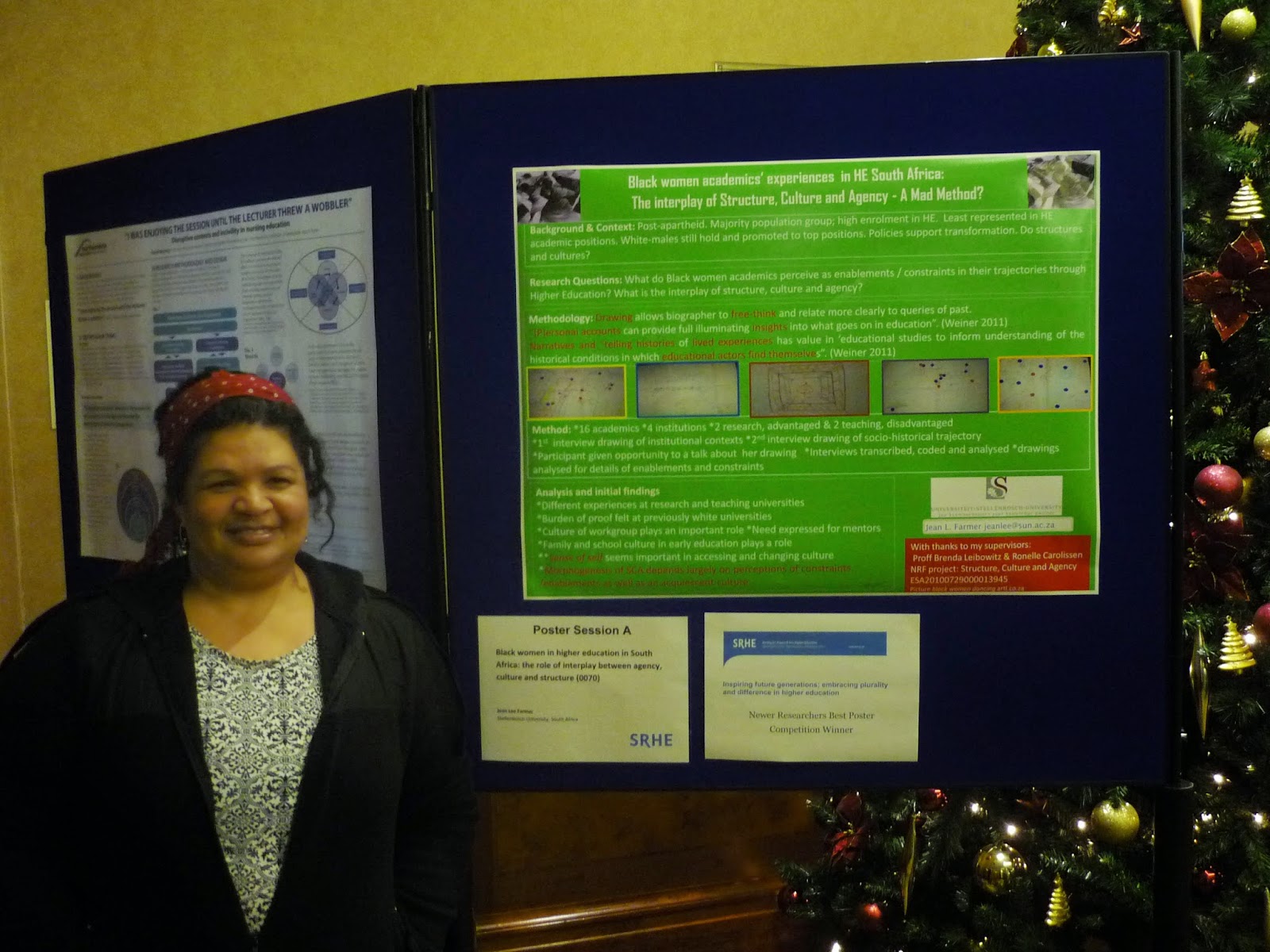
Jean Farmer's Poster at the SRHE

Jean Farmer at the SRHE NR Conference, in front of her poster
Here is some wonderful news from Jean Farmer. She is at the SRHE conference, but first attended the SRHE New Researchers conference. She writes: "I won first prize at the SRHENR conference.  A certificate. 50GBP voucher. And my poster goes up on the website and in the London offices of SRHE. My poster has much less information than the other posters but it was judged on poster as well as presentation. 'Enthused discussion of her work and clear explanation of a methodology and thought-provoking method'."

Jean's PhD is part of the Structure, Culture and Agency research project.  

Congratulations Jean!


Thursday, 4 December 2014

The SCA study as ‘currency’ for change: reflections on what this might mean going forward


A key component of the entire SCA project has been that of reflection. Our very first data collection activity required us to reflect on institutional positions, polices and perspectives with regard to teaching and learning. We also essentially asked our interviewees to reflect on their own professional learning, and at then at various points in the project, we as the research team were asked to reflect: on the experience, on the collaboration and on our own professional learning. And then we were asked to contribute to this blog – to share through this less formal yet equally revealing medium, an experience, a process, an event, that came about as a result of the study. Thus, some further reflections …
I spent quite a bit of time contemplating what might be an appropriate title for this posting. What did I really want to say in reporting on a particular outcome of the study? Telling a story was one thing – and might have some value or generate some interest – but my sense was that the sub-text would be more interesting. I was curious about the extent to which my enthusiasm about what had been achieved (uncovered?) as a result of the study at my institution might be clouding my judgment as to what was really happening – and potentially could happen – in changing conversations about teaching and learning at my institution.
But first the story …
As part of the larger study and working with the different data sets (document analysis, survey and in-depth interviews) we (Brenda, Nicoline, Jean and I) worked on our institutional case study report. This was a challenging process as we grappled with issues around audience (who would read this tome?), and argument (what message did we want to get across?). We were fortunate, however. Brenda, as the principal investigator on the project, provided much of the preamble for all of the institutional case studies and this provided an immediate way into the writing process. Nicoline and Jean were both working on their PhDs which were situated within the study. Their scholarly insights helped to strengthen the analysis and the discussion. We shifted between using ‘report-like’ text and following a more discursive approach – highlighting enablers and constraints for the professional learning of academics in their teaching role while seeking to understand what this might mean for teaching and learning at the institution. The institutional case study report is available on request (email brenda@uj.ac.za), its contents are not the focus of this posting. What is interesting is how the document emerged as an instrument for change.
The case study report served at the institution’s Committee for Learning and Teaching at a time when a task team had been commissioned by the Committee to investigate the Promotion and Recognition of Teaching at the institution. This proved serendipitous as the task team took the research findings as set out in the case study report on board as a point of departure for their work. As their set of ground-breaking recommendations (including issues relating to promotion, teaching sabbaticals and fellowships, and peer review of one’s teaching) went out to faculties for comment, an opportunity arose via the annual in-house Scholarship of Teaching and Learning conference to capitalise on these different outputs and activities. Thus we conceptualised a closing event for the conference that would bring together the findings from the case study report and the recommendations of the task team in a unique way exploring: “New ways of talking about teaching: Acknowledging teaching as an institutional good”.
The session was made up of short inputs on key aspects from the case study report and the task team’s recommendations. These were interspersed with opportunities for ‘multi-group brainstorm’ sessions during which responses from the audience of over 100 academics were captured in real time and displayed on the screens in the venue. The excitement was palpable and the response both positive and interesting as people spoke about how the recommendations will let them ‘come out of the teaching closet’, but also how they expressed concerns about what exposure of their teaching practice to peer review might mean for them.
I believe the event was special and it felt good to end the conference on a high note. But what about that sub-text I spoke of earlier? The interesting bits lie beneath the story. There is the issue of agency, both corporate and personal. In conceiving the session with colleagues from the Centre for Teaching and Learning in the way that we did – using the audience, the technology – represented a considerable risk on my part as the one who would have to stand in front and manage the process. I was willing to take the chance because I believed that the institutional case study report provided credibility and substance. As a group we were confident as we sought to ‘deal’ with audience in a currency we felt they would understand and value (research!). This same ‘currency’ was recognised when the task team referenced the study in their report.
Another issue relates to the responses of the academics. The excitement about the different recommendations made to recognise teaching, on the one hand, and the hesitancy to accept a review process on the other hand. These are matters that are unfolding as I write and as the faculties submit their responses to the recommendations. Already applications for teaching fellowships have been called for. It will be instructive to see how these processes evolve.
But finally, it is about effecting change (dare we use the word ‘transformation’) across the system. It is about a multi-site study funded nationally to support such change. It is about how change takes time (this SCA study has been ongoing now for four years), and how those of us in academic development (agents) have to take risks both individually and corporately to use what has been achieved to challenge existing structures and adopt new discourses around teaching and learning. To date the project has generated a number of outputs in the form of journal articles (over and above the different institutional case study reports). The three PhD students have all made significant progress and as I write, a number of other publications are in various stages of preparedness. This is important not only for the contribution this makes to scholarship, but also because this is the currency we need to use to effect change, to enable us to take risks and to stand up ‘at home’ for what we believe in so that we might alter the landscape. I remain cautiously optimistic.
Susan

Monday, 24 November 2014

Presentations at Heltasa, Free State University, November 2014


The Structure, Culture and Agency team presented one panel and two individual papers at the annual Heltasa Conference at Free State University in Bloemfontein in November 2014. The panel consisted of a series of presentations on the research findings in relation to institutional context:

                              
Final structure, culture and ageny panel from Brenda Leibowitz

Jeff Jawitz and Teresa Perez from UCT made an interesting presentation about choices to participate in professional development activities, attitudes towards time and perceptions of risk:

                              
Jeff heltasa conf presentation nov 2014 from Brenda Leibowitz

And finally, Lynn Quinn and Jo-Anne Vorster made a presentation about their PGDIP in HE and the need to research lecturers' learning approaches, in the same way that there is a need to research students' learning approaches: